Category Archives: Growth

Networking Hack #2 – Return the Favor

In college, I dreaded networking the most, not because I didn’t have brilliant questions to ask, but because I felt I as a student could not provide anything in return while I usually asked for something – information, a job referral, a contact, etc. To me, the scale was out of balance. As a result, the notion of being indebted haunted me and impaired my confidence at the meetings.

Honest Networking

It was not until I was approached by students to set up networking meetings that I realized I was not as resourceless as I thought I was in college. When thinking “Oh, I wish student A would have done this when we spoke last week”, I also learned to see “I really could have helped Alumna B when I met with her for an informational interview a few years ago”. After many rounds of reflection, I discovered the networking meeting could be an equal information exchange rather than one-way street. I could wear both hats – to find out answers to my networking requests (“the taker”) and to understand the other person’s aspirations and offer to help (“the giver”). Had I been back in college again, I would not have let the limited experience of my college-self impact me negatively. There are many ways to return the favor and stay in touch in the long term, such as giving feedback, sending relevant information in their areas of interests, introducing contacts, etc.

scale-slides-03

I did not recognize how powerful giving feedback is until I started blogging and have been in dire need of suggestions to improve my blog. I want to know if I have articulated my ideas, what topics my target audience would be interested in, etc. Thus, I reached out to a mentee of mine and asked her for a list of topics she is curious about. Thanks to her recommended list, I have written “Networking Hack #1” on how to conduct information interviews and this article on how to leave a long-lasting impression and stay in touch. Similarly, anyone could do the same for his/her networking contact by offering constructive feedback. When attending a company-sponsored networking event, you could connect with the recruiters and provide thoughts on what you enjoy and what else to include to make it even better. Comments and suggestions are in high demand but hard to get since we often delete event survey emails without participating. If you offer what the recruiters care about without them even asking in the first place, you will definitely stand out. What’s more, you get to connect with them on a personal level rather than being just a name among the survey results. Another example is if your mentor works in an industry you are familiar with, such as Target or General Mills, you could offer personal insights on certain products experience. I am sure you will have a fun idea exchange!

Apart from contributing personal ideas, another way is to share resources in the field that your contact is interested in. Resources could range from book recommendations and news articles, to contacts to introduce them to and professional development event information. I found out recently that one of my contacts was moving to Chicago.As someone who have been through moving to a completely new city not knowing anyone, I offered to introduce him to friends I know in the area. Someone who I find very inspiring has opened two women’s wear boutique shops in Minnesota. Since I have been quite a shopper myself, I sent her articles on the retail/fashion industry. I also shared her store information on Facebook, hoping to drive more store traffic. I am a firm believer that as long as I am thoughtful, whether the information could be of help or not, my contacts will appreciate the effort I put in. More importantly, I feel happier when I could do something for others.

To stay in touch in the long term, you could follow up periodically and give a status update. When others invest in you by volunteering time to meet with you, introducing their contacts, and forwarding your resume, etc, they would love to know what happens to you in the end. I did not empathize that feeling until I start mentoring students. I would wonder “what happened to Student A’s interview?”, “Did Student B meet my coworker and find it helpful?”, etc. Sending a brief email update is always a nice way to reconnect and gives another opportunity to keep you on your contact’s mind.

No matter what you do, it takes genuine interest to understand what your contacts care about and a well-informed mind to be resourceful. From checking your contact’s Linkedin profile and asking questions at the meetings, you will notice things that matter to them, such as the industries they are in, professional goals, college affiliation, personal hobbies, etc. To discover the relevant resources, you could stay in the know by not only following the news, but also turning to the Linkedin Newsfeed. I was able to find a networking event through Linkedin that one of my contacts might be interested in attending. If you are at a loss of how to help, you could always try “what can I do to help you”. Someone asked me this question before and I was able to ask for a favor.

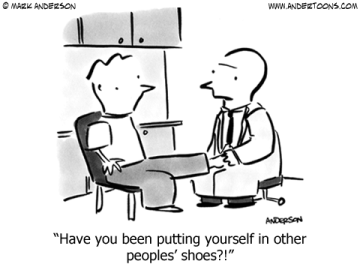
When you initiate to help your networking contacts, you will strike them as thoughtful and having their interests in mind, instead of being all about “What I want…” If you share similar feelings as I once had in college, why not try these suggestions of giving feedback, providing relevant information, and sending periodic update emails. I hope my tips will help you generate more ideas. When in doubt, always think in your networking contact’s shoe and ask yourself “if I was him/her, how would I like to be treated?”
 

Shoes


I would love to hear from you! Your thoughts are always welcome! You could leave a comment or email me at sijieand500words@gmail.com

New Look for the Blog and Holiday Break

I am excited to share that I have officially registered the domain of my blog! You could now put down “sijieand500words.com” to locate my site. What’s more, I have upgraded the site to the premium plan so that it has a cleaner view with open sans typeface, gets rid of irrelevant ads, and enables the subscription function (on the upper right corner for desktop and at the bottom for mobile views). I not only love the new look, but also believe it will give my readers easy access to the website and improved reading experience.

With the holidays coming, I am going to be on a writing break. As much as I love writing, producing a piece in clear logic and precise words does take up lots of time, most of which I spent locked up at home. In the holiday season, I would rather spend more time with friends and focus on other priorities, such as training for my first half marathon, which will take place on January 17th, 2016. Unfortunately, I overtrained in early November and had some IT band pain. The recovery has put me behind on training schedule by a couple of weeks. With the goal of finishing the race under two hours, I need to put in more effort while avoiding further injuries.

Though I won’t be updating the blog every other Sunday, there is still a chance of me publishing in the next couple of months. Remember to check back for updates! In the meantime, feel free to check out some of the blogs I follow:

Phil’s Career Blog – http://www.phils-career-blog.com/

Written by my college professor, who is an ex-consultant/corporate strategist passionate about teaching and mentoring, the blog focuses on career management and business thinking. The “Career” section includes pieces on Interviewing and Networking that are must-read.

If you are a young professional, Phil gave a great podcast this year to the University alumni community on managing the one’s career after college – It’s Not Just Luck: Increasing Your Odds for Early Career Success. I cannot recommend it enough.

James Clear – http://jamesclear.com/

The blog centers on habit formation and performance improvement. It is under his influence that I decided to write more to form a habit. It is also due to his article that I set my mind to prioritize writing. To be honest, I cannot keep up with his publishing frequency. However, it matters more to internalize and practice the learning than to count the number of articles one reads. Thus, when I do read, I usually try to apply the takeaways.

Ellen Chisa – http://www.ellenchisa.com/writing/

I recently stumbled upon her blog via her article “Have Some Coffee”, the points of which I can’t agree more with. She beat me to it in sharing tips on “stay in touch” and “return the favor”. I am planning to cover them in “Networking Hack #2”, so I will make sure my post has more examples, whenever I get a chance to finish it!!

I will resume the normal writing schedule in late January, hopefully with good news to share on the half marathon!

Until next time,

Charlie Brown


Networking Hack #1 – Make it Easy for Others to Help You

Have you sent lots of networking emails but gained little traction?

Have you set up networking meetings that ended with no job prospects?

Sometimes feeling like the resume guy in the cartoon?

Unfocused Networking

Chances are you are not doing it right. To have high request response rate and productive networking meetings, think of ways that are convenient for others to help you. First, you must know what you want to achieve from the meeting, then incorporate the purpose in the introduction email, and lastly follow up with easy to execute plans. All these ideas are drawn from my personal experience of being on both sides and lessons passed down from the wise.

Network with a clear purpose

Networking meeting should always start with a purpose, which will help you narrow down what information you are seeking and who to talk to. A networking meeting without a well-thought-out purpose is a waste of time for both parties. Moreover, it is quite likely that the connection won’t even accept the request in the first place since he/she might be wondering “why me?” Thus, you should never network just to check the box. Instead, take the opportunity to explore topics such as “Does the company has the roles that fit my background and career aspirations”, “Does the team has the right culture that aligns with my personality”, etc. Further, networking does not need to be limited to job searching. You could also learn from those with intriguing career paths and get mentored.

Once you determine what questions to ask, set up meetings with those that could give you the answers. Linkedin is usually a great resource to research and gauge if one is the right connection. Relevance of one’s background to your networking purpose always matters more than the title he/she holds. No matter what decision-making power he/she has, if you are a strong candidate for a job, eventually your resume will be passed onto the hiring manager. It happens a lot in my office that if there is an opening on the team, the hiring manager will ask everyone if they know any good candidate. What’s more, you could always start with the junior analysts to “knock out the basics” and then to move up to people at the senior level to understand the team culture and strategy.

Articulate the purpose in the introduction email

With the purpose in mind, you narrow down the list of connections. Now it is time to set up a meeting. However, in the initial email, sometimes networkers fail to explain clearly how the request relates to the connection. I have outlined two requests that I encountered and my initial reactions. I have abbreviated the emails and kept them anonymous.

Case A

Email: “…. I am an international student looking for advice…”

Reaction: What particular areas of advice are you looking for? Academic? Adapting to the US culture? Job search? Leadership? What’s more, even under each area, there are multiple subtopics. For example, under job search, stand-alone topics could include networking, getting interview invites and interviewing. When the topic is too general, I will be at a loss about where to start and uncertain about how much time commitment the meeting is going to be.

Case B

Email: “… I am looking to move to Houston to start my career in finance. I am wondering if you have any advice or know anyone I should reach out to as I begin my application process…”

 Reaction: This should be a direct request for an informational interview, where I could learn more about your background. You could tell me what finance jobs are of interest and what companies you have looked into in Houston. What’s more, I am more likely to introduce you to my connections once I get to know you beyond the email.

Knowing that I could have high expectations, I nevertheless responded to both emails. However, there is room for improvement to eliminate any potential questions from the connection.

Propose specific actions in the follow-up email 

After the networking meeting, if you are interested in potential employment, propose ways that the connection could easily take part in. I have outlined a couple of actions and their enhanced versions.

Scenarios Actions Further Improvement
Available job posting of interest Tell the connection you have applied Email the connection a job description with your resume so he/she could forward directly to hiring managers
No job posting of interest at the moment Thank you email to show appreciation Commit to check back with the connection later, specify what types of position you are interested in and include the resume, in case he/she could forward your resume to other companies that are hiring

Overall, you should bear in mind the goal of minimizing the amount of work your connection needs to do.

We could all agree that people are more likely to act upon something if the undertaking is easy with clear directions. Our connections have competing priorities in life that they could easily say no to the meetings, since they don’t have any obligation to volunteer their time. Invest time and efforts in making it easier for others to help, such as knowing what you want to gain from the meeting and writing clear introduction and follow-up emails. In that way, you are more likely to get what you want.

Bonus – if you could read Chinese, below is a great article that inspires me to write this post. Although some points are overlapping, I try to make my examples as relevant as possible to college recruiting. I believe it is through concrete examples that one really learn to practice the ideas. http://www.dennythecow.com/?p=411

P.S. I will try to get back to my publishing consistency of every other Sunday evening. If you don’t want to miss a post in case I am behind schedule, be sure to sign up for notification via email. In “Hack #2” post, I will share my ideas of “giving” in the networking dynamic. Stay tuned!

Ace the Recruiting Season – Part B

In the recruiting process, there are usually two stages – stage one, pass the initial resume screen for interviews; stage two, nail the interviews to get the offer. In Part A, I touched on a few points that could increase your odds of being invited for interviews (stage one), with the condition that you already have a solid resume. For international students, many couldn’t pass stage one, as a result of work visa restrictions, lack of work/leadership experience, etc. Thus, if you have been invited to interviews, congratulations, you are half-way there! The actual interviews are equally important if not more, because if you fail, all the extra effort leading up to the interviews ends with nothing. In this post, I am going to share a few interview tips based on my experience of serving on the recruiting team and what I have learned from the others. To excel in interviews, you should prepare for a few highlights when answering the “Tell me about yourself” question, develop a portfolio of stories, and strictly follow the STAR technique.

Include a few intriguing points when answering “Tell me about yourself”

“Tell me about yourself” or “Walk me through your resume” is generally the first question interviewer asks. Since this might be the only question that you have full control over (versus answering the behavioral questions later with given situations), you need to make a good first impression. What’s more, because the interviewer could read your resume, you can’t just list off your experiences again. You could add more color to the resume bullet points by explaining the progression of responsibilities and the “why”s behind some major decisions. To prepare for the answer, think through questions such as:

  • How did you decide on the major?
  • If you have been working part-time for one year, are you always doing the same thing or have you asked for additional responsibilities?
  • Why did you decide to take a part-time internship with employer A not B?
  • Why did you decide to study abroad, etc

By addressing some of these questions in your answer, you show your motivation and qualities (eager to learn, willing to take on challenges, etc). You could also highlight a few accomplishments that you are most proud of, which could pique the interviewer’s interest and probe him/her to follow up with additional questions. As a result, you will be more in control of the conversation. Last but not least, remember to keep the answer under 2-3 minutes.

Prepare stories that show your qualities in different scenarios

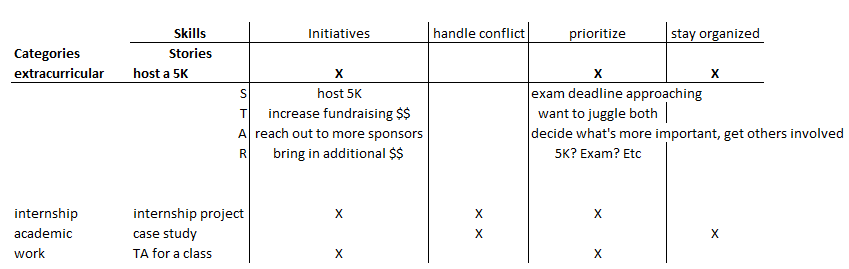
After “Tell me about yourself”, recruiters usually will ask behavioral questions. As a greeter for on-campus interviews (company representatives who interviewees could talk to before the interview), I remember vividly that one interviewer commented “I wish he could speak to more than fundraising for his fraternity!” Truth be told, I used to be that applicant who couldn’t stop talking about organizing a 5K event. As I could completely relate to, during the interview, you get nervous and do not have extra time to consider the portfolio of stories. To avoid this issue, develop a list of stories that covers various aspects of the college life, such as internship, part-time job, extracurricular, and class project. You could build a grid that looks like this:

Grid

Follow the STAR technique

Once deciding on the story to answer the question, you are expected to walk the interviewer through Situation, Task, Action, and Result. Interviewers from my company use a booklet to keep notes for each candidate. In the booklet, the note sections are divided exactly into the four parts mentioned above (S-T-A-R). This example indicates that you cannot be wrong explaining each component. Two other points I would like to emphasize regarding STAR are: 1) spend more time explaining Action and Result; 2) focus on the actions you take and the results associated with your actions. When talking about situations of working on a team, interviewees sometimes fail to communicate what their roles are on the team. With STAR, You could further enhance the grid:

STAR Added

In conclusion, once you prepare the introduction (“Tell me about yourself”), list out the stories for the behavioral questions, and address S-T-A-R components of each one, all you have left is to practice, practice, and practice!

Best of luck!!


Enjoy what you are reading? Subscribe to my blog by putting down your email address. You don’t want to miss the next update on informational interviews!