Ace the Recruiting Season – Part B

In the recruiting process, there are usually two stages – stage one, pass the initial resume screen for interviews; stage two, nail the interviews to get the offer. In Part A, I touched on a few points that could increase your odds of being invited for interviews (stage one), with the condition that you already have a solid resume. For international students, many couldn’t pass stage one, as a result of work visa restrictions, lack of work/leadership experience, etc. Thus, if you have been invited to interviews, congratulations, you are half-way there! The actual interviews are equally important if not more, because if you fail, all the extra effort leading up to the interviews ends with nothing. In this post, I am going to share a few interview tips based on my experience of serving on the recruiting team and what I have learned from the others. To excel in interviews, you should prepare for a few highlights when answering the “Tell me about yourself” question, develop a portfolio of stories, and strictly follow the STAR technique.

Include a few intriguing points when answering “Tell me about yourself”

“Tell me about yourself” or “Walk me through your resume” is generally the first question interviewer asks. Since this might be the only question that you have full control over (versus answering the behavioral questions later with given situations), you need to make a good first impression. What’s more, because the interviewer could read your resume, you can’t just list off your experiences again. You could add more color to the resume bullet points by explaining the progression of responsibilities and the “why”s behind some major decisions. To prepare for the answer, think through questions such as:

  • How did you decide on the major?
  • If you have been working part-time for one year, are you always doing the same thing or have you asked for additional responsibilities?
  • Why did you decide to take a part-time internship with employer A not B?
  • Why did you decide to study abroad, etc

By addressing some of these questions in your answer, you show your motivation and qualities (eager to learn, willing to take on challenges, etc). You could also highlight a few accomplishments that you are most proud of, which could pique the interviewer’s interest and probe him/her to follow up with additional questions. As a result, you will be more in control of the conversation. Last but not least, remember to keep the answer under 2-3 minutes.

Prepare stories that show your qualities in different scenarios

After “Tell me about yourself”, recruiters usually will ask behavioral questions. As a greeter for on-campus interviews (company representatives who interviewees could talk to before the interview), I remember vividly that one interviewer commented “I wish he could speak to more than fundraising for his fraternity!” Truth be told, I used to be that applicant who couldn’t stop talking about organizing a 5K event. As I could completely relate to, during the interview, you get nervous and do not have extra time to consider the portfolio of stories. To avoid this issue, develop a list of stories that covers various aspects of the college life, such as internship, part-time job, extracurricular, and class project. You could build a grid that looks like this:

Grid

Follow the STAR technique

Once deciding on the story to answer the question, you are expected to walk the interviewer through Situation, Task, Action, and Result. Interviewers from my company use a booklet to keep notes for each candidate. In the booklet, the note sections are divided exactly into the four parts mentioned above (S-T-A-R). This example indicates that you cannot be wrong explaining each component. Two other points I would like to emphasize regarding STAR are: 1) spend more time explaining Action and Result; 2) focus on the actions you take and the results associated with your actions. When talking about situations of working on a team, interviewees sometimes fail to communicate what their roles are on the team. With STAR, You could further enhance the grid:
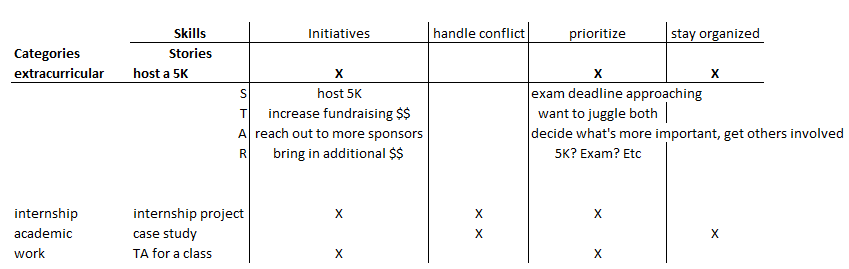
STAR Added

In conclusion, once you prepare the introduction (“Tell me about yourself”), list out the stories for the behavioral questions, and address S-T-A-R components of each one, all you have left is to practice, practice, and practice!

Best of luck!!


Enjoy what you are reading? Subscribe to my blog by putting down your email address. You don’t want to miss the next update on informational interviews!     

Out-of-State Job Search & My Two Personal Stories

Preface: I am writing this article because my schedule doesn’t allow me to speak as a panelist at the workshop hosted by my alma mater. I am writing down my personal observations and stories, hoping it could make up for my absence. I will resume my “Ace the Recruiting Season – Part B” in the next two weeks.

If you are an international student struggling to find local employers to hire you due to work visa constraints, I strongly encourage you to look for opportunities out of state, especially in major metropolitan cities (i.e. NYC, Chicago, San Francisco, Houston, Los Angeles, etc.). After moving to Houston due to an internal transfer, I was amazed at the sheer volume of international graduates working in Big Four accounting firms in Houston. Thinking about my accounting friends in Minnesota with equally impressive resume, I concluded they have a tough time because they only looked at local opportunities. In this article, I will quickly highlight “why major metros?”, share two personal stories on how I end up in Houston, and conclude with two tips on out-of-state job search.

The biggest advantage major metropolitan cities have is the mass scale of opportunities. Take Big Four accounting firms as an example, the new hire class in the Houston office could have 100 people each year, while the smaller regional office might only have 30-40. The numbers are made up, yet the contrast in sizes exists. What’s more, many firms in internationally-known cities have global operations. As a result, the ability to work in multicultural environment is more sought after and could be easier to demonstrate by candidates with international background. Overall, employers in these cities usually have a great record of hiring international graduates, are more familiar with the work visa application process, and show a deeper appreciation of hires with international experience.

At this point, you should be convinced that metro cities have more opportunities, but could be questioning what advantages you have as an out-of-state candidate. The general answer is that you may not have any. However, if you would like to stay in the US after graduation and if you are out of luck with local companies, relocating and committing to the job search is the only solution. Moreover, once you have established great connections with alumni in those cities that they would like to refer you, you are on the same level playing field.

I did not heavily search for jobs outside Minnesota in college. However, I am working in Houston thanks to the connections I have made in college and the office. They first led me to an internship with my current employer, then to a job in Houston.

When I was interviewing for internship with my current company, I reached out to someone I knew on the recruiting team. He and I used to serve on the executive board of a student organization together, so he knew my strong work ethics and leadership. He offered time to answer my questions about the company, shared insider tips, and even informed me the interview styles of my interviewers. At the company’s on-campus info session, I met my Houston manager who was also on the recruiting team. I stayed in touch with him during my internship and invited him to the intern project presentation. Two years later as I was applying for the internal transfer in Houston, he turned out to be my interviewer! I am sure the quality of my work and the relationship we have formed since the on-campus info session give him confidence that I will be successful on the job. Both personal stories have illustrated the importance of building a good brand to convince others to either recommend you or hire you.

The two anecdotes described the relationships I have developed in a period of time. How could you, as out-of-state candidates, establish trust with alumni that you might have never met before? I consider email communications and preparedness for the informational interviews as critical evaluation points. If I were to break down the networking process into several stages, the points listed are things to consider:

  • Stage 1: Initial Email 

In a couple of paragraphs, could you explain who you are, why you are interested in the company and the geographic location, and ask to schedule a time to talk? Brief emails save alumni reading time and the “why”s reveals how serious your interests are.

  • Stage 2: Follow up

If the alumni ask you to check back a couple of weeks later, are you able to follow up? I see it happening quite often that not many students actually follow up.

  • Stage 3: Phone Conversation

Have you done enough research on the company and what the alumni do? Have you browsed through the company’s website and even checked out his/her Linkedin page? I have also written about asking good questions in this post.

  • Stage 4: Thank You, Ask and Stay in Touch

In the conversation or thank you email, have you asked about potential opportunities in the firm? I didn’t do a good job myself when I was a student, but I learned from the students who reached out to me. They usually followed up with their resumes, a short summary of the phone conversation, and something along the lines of “should your company has an opening, I would love to be considered”. Personally I am not turned off by the ask, because I know exactly their level of interests in employment.

Apart from the tip of maintaining relationships through email and phone communications, the other tip is to visit the alumni in his/her city if possible. Nothing strengthens the bond more than a face-to-face meeting. Before you travel to the city, it will be much more convenient if you know how to drive, because some of the major cities are not public transport friendly, i.e. Los Angeles and Houston. Can you imagine telling the alumni that you can’t meet in a certain location because it is not on the bus route? I’ve written similar point in this post.

Although out-of-state job search is more challenging, it may be your best and only option. When there is a will, there is a way. If you are fully committed, build relationships with others by consistently showing outstanding performance and keeping good communications, eventually people will not hesitate to recommend you to their employers.

Best of luck!

Ace the Recruiting Season – Part A

The recruiting season for internships and full-time jobs will be starting very soon on campus. In a series of posts, I hope to highlight things applicants should pay attention to, based on my experience in college and serving on the recruiting team of my employer. This series is by no means an exhaustive list of what to do (workshops hosted by the career center will do a much better job). Instead, I will try to focus on specific actions that sometimes get overlooked but executing them well will increase your chance of landing the desirable positions. In this post, I am going to talk about three things – look the part, ask well-researched questions, and follow up.

Look the Part

Stick to the dress code in the recruiting events. The expectation is to wear business casual for information session (It doesn’t hurt to overdress.) and business professional for career fair. Recruiters meet a lot of candidates and they might spend only 3-4 minutes talking with each one, so they could be making some quick decisions on whether you are a strong candidate or not. Based on the way you dress, you would want him/her to immediately picture you working in the professional setting.

What’s more, look confident. Non-verbal languages, such as handshake and eye contact, affect more how we are perceived than verbal ones. If you are not confident, your behavioral cues will be picked up quickly by the recruiters. In college, initially, my identity as an international student created an internal hurdle – I didn’t have much work experience and now I needed to convince the recruiters in a language that is not my mother tongue to hire me over my American counterparts? “Fake it till make it” was the motto I follow. Plus, I assured myself that studying abroad already demonstrated my adaptability and willingness to lean into discomfort. I highly recommend watching Amy Cuddy’s TED talk “Your Body Language Shapes who You are” to get more confidence boosters.

Ask Well-Researched Questions

Once you pass the introduction stage, it is time to ask some specific questions on the company. I assume that you have already done the research, so you know what positions they are hiring and would not ask for any information that is readily available on the company website. I summarized my suggestion to be “statement + follow-up question”. The statement has two purposes – one, to introduce the follow-up question; two, more importantly, to demonstrate that you have done good research. I have listed out some good and bad examples of the questions.

Bad – How many different business units does your company have?

Good – Your company has multiple business units, such as X and Y. Which business unit are you involved in and what is your experience like?

Bad – How would you describe the culture of your company?

Good – Your company stresses community involvement and teamwork. Could you share some of your involvements?

Follow up

If you are still interested after the conversation, ask if the company will be on campus for future events – when deciding who to invite to interviews, my company also considers candidates’ attendance at events to gauge their interests. What’s more, get his/her contact information in case you have questions in the future or you would like to grab coffee later. When speaking at recruiting events or career skill workshops, I have met a lot of students who asked to stay in touch, but not many followed through. If you do what you have committed to, you will stand out immediately among the candidate pool. Furthermore, in your email, it’s always appreciated to remind your contact when and where you met and highlights of the conversation.

Make a good initial impression by looking the part, show your interests in the company by asking well-researched questions, and further demonstrate the interests by following up in the future. By following these three steps, I am confident that you will be one step closer to getting the invites to interviews.

If You Were to Visit Minneapolis…

After moving down to Houston, I have been asked frequently “Which city do you like more, Houston or Minneapolis?” I don’t think I have explored Houston enough to reach a conclusion, but I could assure you that Minneapolis is a great city to live in. It is such a hidden gem, often buried inches deep down by at least four months of snow.

Now that summer is almost over (the best season in Minneapolis and the worst in Houston), I decided on a last minute getaway to Minneapolis this weekend. The author of “My Open Love Letter to Minneapolis” has already done a great job summarizing the essence of the city, but I would like to add a more personal flavor and share some of my favorite places. Note that I am going to talk about St Paul and Minneapolis altogether. Since the two biggest cities of Minnesota are only ten miles away, people usually see two as one, hence the name “Twin Cities”.

  • Parks within a Hand’s Reach

A hand’s reach is exaggerating, but based on rankings conducted by the Trust for Public Land, Minneapolis has “a park within a 10-minute walk of most homes”. Since Minneapolis is blessed with natural landscapes such as lakes and rivers, a lot of parks or trails are built around the beautiful sceneries. When I decided to run regularly in the summer of 2013, it was the trees, green grass, and flowing water along the trails that motivated me to go further for more “eye therapies”.

Top Spots:

Chain of Lakes – home to Lake Harriet, Lake Calhoun, Lake of the Isles, etc

Stone Arch Bridge – a pedestrian bridge that runs over the Mississippi River and a good spot to see Minneapolis downtown skyline

West/East River Parkway –the trail along the Mississippi is perfect for a long run and some hill running

Minnehaha Falls – never had the opportunity to go, but heard it’s great to see fall colors without the hassle of leaving the city

Recommended Activities:

Kayaking, canoeing, paddle boarding, biking, running, roller blading/skating, etc

*I used to buy Groupons from Wheel Fun Rentals every summer to check out their kayaks and canoes by the Chain of Lakes.

*NiceRide is a great public bike rental system that has convenient docking stations around the Cities.

  • Art and Cultural Events

If you are into art, you can’t miss Minneapolis Institute of Art. It not only carries great permanent collections, but also well-known temporary exhibits, those of which I have been to include Rembrandt, Terra Cotta Warriors, and Matisse. The cherry on top is free admission! Besides the Impressionism paintings, my favorites are Chinese art, some of which donated by Ruth and Bruce Dayton. Ruth Dayton convinced her then husband (part of the Dayton family that owns Target Corporation) to acquire more than 700 objects from China. According to New York Times, “the museum’s Chinese art collection is now considered one of the finest and most comprehensive in the country”.

If you ever listen to NPR over the weekend, you might be familiar with the town where “all the women are strong, all the men are good looking, and all the children are above average”. It is Lake Wobegon, from A Prairie Home Companion, a radio show originated from the Fitzgerald Theater in downtown of St Paul, Minnesota. As a friend of mine put it, “it shows the quintessential Minnesota culture”. I am a big fan of the program, partly because I could catch all the jokes on Minnesota. I regret not going to the Theater to watch Garrison Keillor live and wish I could have the opportunity before he retires in 2016.

Recommended Activities:

Visit Minneapolis Institute of Art now for the 100th year celebration and in spring for annual Art in Bloom 

Catch a show in any performing center – Gutherie, Orpheum, Ordway, Minnesota Orchestra, St Paul Chamber of Orchestra, etc

Watch a movie or music performance in the park during the summer time 

Attend a festival – Uptown Art Fair, Grand Old Day, Minnesota State Fair, Stone Arch Bridge Festival, Northern Spark, etc

  • Walkable Neighborhoods

The Twin Cities have a lot of neighborhoods that are pedestrian-friendly and filled with restaurants and shops, such as the Northeast Minneapolis, Uptown, Selby and Cathedral Hill, and Grand Avenue. You could drink, dine, and shop all on one trip, without the constant worry of finding the next parking spot. These neighborhoods abut single family homes and are usually away from the noisy traffic. I always feel a peace of mind walking in these neighborhoods.

Favorite coffee shops:

Nina’s Coffee Café

Dunn Brothers on 3rd Avenue and 1st Street, next to Stone Arch Bridge

Rustica Bakery

Nature, Arts, and Culture, these are what I like the most about the Twin Cities. When you live in a place for a while, the culture and values of that city slowly rub on you. Six years of living in the Twin Cities definitely led me to become more fitness-conscious and more cultural, which will always stay as part of me. Now that I am living in Houston, I having been exploring and peeling off the concrete layers of this urban sprawl. Give me some time and I will write an article on Houston too!